The first SAPPHIRE Workshop took place in Accra, Ghana, from 13–18 April 2026, bringing together medical physicists, engineers, clinicians and accelerator scientists for a week of training, practical learning and international collaboration.
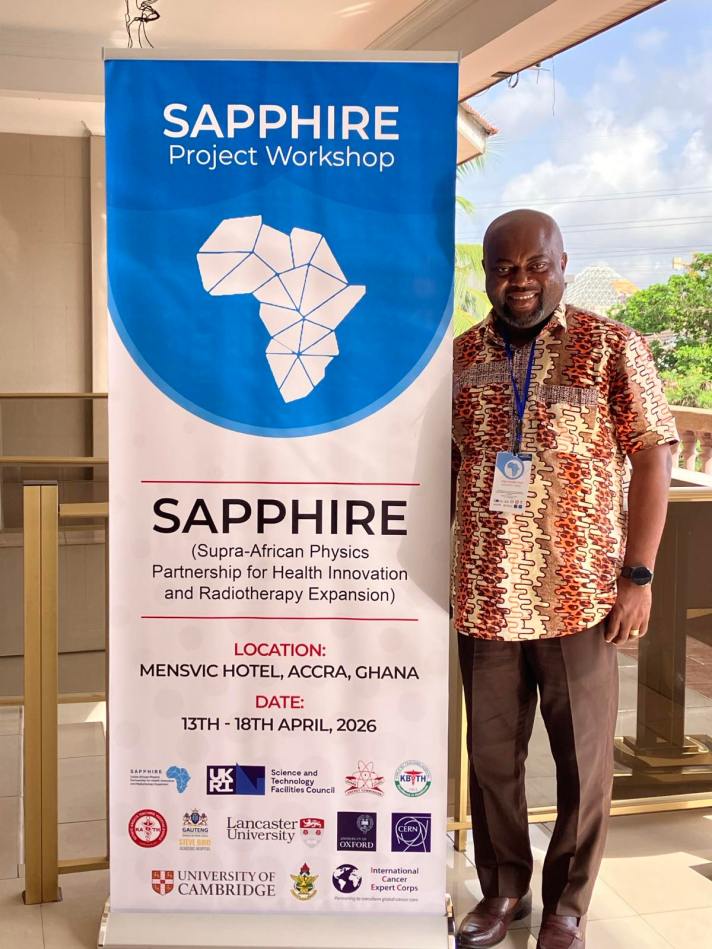
The first SAPPHIRE Training Workshop was held from 13–18 April 2026 at the Mensvic Hotel in Accra, Ghana, bringing together medical physicists, engineers, clinicians and accelerator scientists from across Africa, Europe and North America.
Organised within the framework of the Supra-African Physics Partnership for Health Innovation and Radiotherapy Expansion — SAPPHIRE, the workshop aimed to strengthen technical capacity in accelerator science and support the reliability and sustainability of radiotherapy services in Africa.
The programme combined lectures, practical sessions and field visits, creating a highly interactive learning environment focused on the real challenges faced by radiotherapy centres. Sessions covered a wide range of topics, including clinical radiotherapy, medical linear accelerators, RF acceleration, beam loading, electron gun systems, magnetrons and klystrons, beam dynamics and steering, dosimetry, radiation safety, imaging in radiotherapy, and quality assurance on linear accelerators.
A key feature of the workshop was the hands-on training using SIMAC software, allowing participants to simulate linac behaviour, adjust RF power, explore beam current and energy relationships, measure RF source characteristics, and practise beam steering. Participants were also given access to the SIMAC licence for one year, enabling them to continue building on the knowledge gained during the workshop.
The opening ceremony brought together representatives from the Ghana Atomic Energy Commission (GAEC), Korle Bu Teaching Hospital, Komfo Anokye Teaching Hospital, Sweden Ghana Medical Centre, and international partner institutions including the University of Oxford, Lancaster University, University of Cambridge, University of Pretoria, Steve Biko Academic Hospital, CERN, and the International Cancer Expert Corps.
In her presentation, Prof. Manjit Dosanjh, SAPPHIRE Project Lead, introduced the objectives of the initiative and highlighted its focus on improving the operational performance of medical linear accelerators through training, data collection, research collaboration and knowledge exchange. The workshop also reflects the broader ambitions of related international efforts, including the STELLA project and the development of robust, fault-tolerant medical linac technologies for low- and middle-income countries.
Participants also took part in field visits to the Ghana Atomic Energy Commission, where they visited research and accelerator facilities, and to the National Radiotherapy Oncology and Nuclear Medicine Centre at Korle Bu Teaching Hospital, where they observed operational radiotherapy systems and exchanged with local medical physics teams on service delivery, maintenance and infrastructure challenges.
As part of the Accra programme, Prof. Manjit Dosanjh and Prof. Raj Jena were also invited to give guest lectures to students at the Medical Physics Department of the School of Nuclear and Allied Sciences, University of Ghana. Prof. Dosanjh spoke on the status of radiotherapy and emerging technologies, including FLASH therapy, while Prof. Jena presented applications of artificial intelligence in radiation oncology.
The workshop successfully strengthened participants’ understanding of accelerator systems used in radiotherapy, reinforced the importance of quality assurance and maintenance strategies, and encouraged stronger collaboration between African institutions and international technical partners.
Participants highlighted the need for continued accelerator engineering training, regional collaboration on linac maintenance, standardized quality assurance programmes, predictive maintenance approaches, and follow-up workshops to monitor progress and support future SAPPHIRE activities.
The SAPPHIRE project team warmly thanks all participants, speakers, facilitators, local organisers and partner institutions for their contribution to a successful and impactful week in Accra.
In the media
We are pleased to share that the SAPPHIRE Workshop in Accra has been featured by MyJoyOnline, highlighting the importance of international collaboration, training and accelerator expertise in strengthening cancer treatment capacity across Africa.
Read the full article here:
https://www.myjoyonline.com/gaec-hosts-major-international-sapphire-workshop-to-boost-cancer-treatment-capacity-in-africa/


